What AI coding agents actually install
I build something almost every day, and these days an AI agent writes most of the code. Again and again I watched it choose the tools for me: the login library, the database, the email API. I kept asking myself three things. Why this one? Would another model pick something else? And is there a better tool out there that I never see, because I’m stuck with the model’s choice?
So I started measuring it. InstallRate gives Claude, GPT and Gemini real build tasks that never name a product, then reads what each answer actually installs. Jarvis, my AI assistant, built it and runs it.
- 100 tasks5 in each of 20 categories, written like real requests, never naming a product
- 3 models, twiceClaude Sonnet 5.5, GPT-5.6 Terra and Gemini 3.1 Pro


- 600 answersThe pick is read from the install command first, then the package file, then the imports
- 60 checked60 random answers checked by hand: 58 right on the first pass, 60 after one fix. The run cost $6.71
Method: installrate.com/methodology
 InstallRatemomenelshamy.com
Four things that stood out
1. Some categories are already decided
In 9 of the 20 categories, one product won more than half the answers. Two won every single one: Sentry for error monitoring and Playwright for end-to-end tests, 30 out of 30, on all three models.
 SentryError monitoring30
 PlaywrightEnd-to-end tests30
 PostHogProduct analytics28
 StripePayments24
 NeonHosted Postgres20
 shadcn/uiUI components19
 AWS S3File storage17
 DrizzleORM (Prisma: 5)16
 ResendTransactional email16
 VercelHosting12
 Grafana and PrometheusLogs and tracing12
 BullMQ and CeleryJob queues, tied12
 SanityHeadless CMS11
 MeilisearchSearch11
 pgvectorVector database10
 LangfuseLLM tracing10
 Socket.IORealtime10PostHog flagsFeature flags10
 Auth.jsLogin and auth8
Run of 2 Nov 2026. installrate.com/leaderboard
InstallRatemomenelshamy.com
The bottom of the list matters too. Auth, feature flags and realtime have no clear winner, so in those categories the agent’s pick still depends on the model and on how you ask.
2. Named isn’t installed
The number I find most useful is the gap between being mentioned and being installed. Supabase came up in 4 of the 30 hosted Postgres answers and was installed in none. Neon got 20. The models know Supabase well. They just call it the alternative.
 SupabasePostgres: Neon got 2040 named in the answer 4, installed 0
 DatadogTracing: Grafana got 1290 named in the answer 9, installed 0
 Cloudflare R2Storage: AWS S3 got 1760 named in the answer 6, installed 0
 MailgunEmail: Resend got 1640 named in the answer 4, installed 0
 AlgoliaSearch: Meilisearch got 1191 named in the answer 9, installed 1
 PostmarkEmail94 named in the answer 9, installed 4
Run of 2 Nov 2026. Write-ups per finding: installrate.com/findings
InstallRatemomenelshamy.com
Here’s what that looks like inside one answer:
Claude Sonnet 5.5npm install drizzle-orm @neondatabase/serverlessInstallRatemomenelshamy.com
A mention shows the agent knows the market. The install is the decision.
3. The models don’t agree
Give three models the same task and you often get three different answers. Auth is the clearest case. Claude reached for Auth.js. Gemini went to Clerk. GPT wrote its own login, with sessions and password hashing, in 4 of its 10 answers.
ClaudeGPTGemini Clerk
 Better Auth
Run of 2 Nov 2026. installrate.com/leaderboard/auth
InstallRatemomenelshamy.com
It goes beyond auth. Claude never installed Prisma; Gemini did 4 times out of 10. GPT kept vectors in Postgres with pgvector 6 times out of 10; Gemini never did. And in 56 of the 600 answers, the agent picked no product at all and built the thing itself.
So “what AI recommends” depends on which AI. If your users work in Claude Code, Gemini’s habits don’t tell you much about them.
4. Resend is taking transactional email
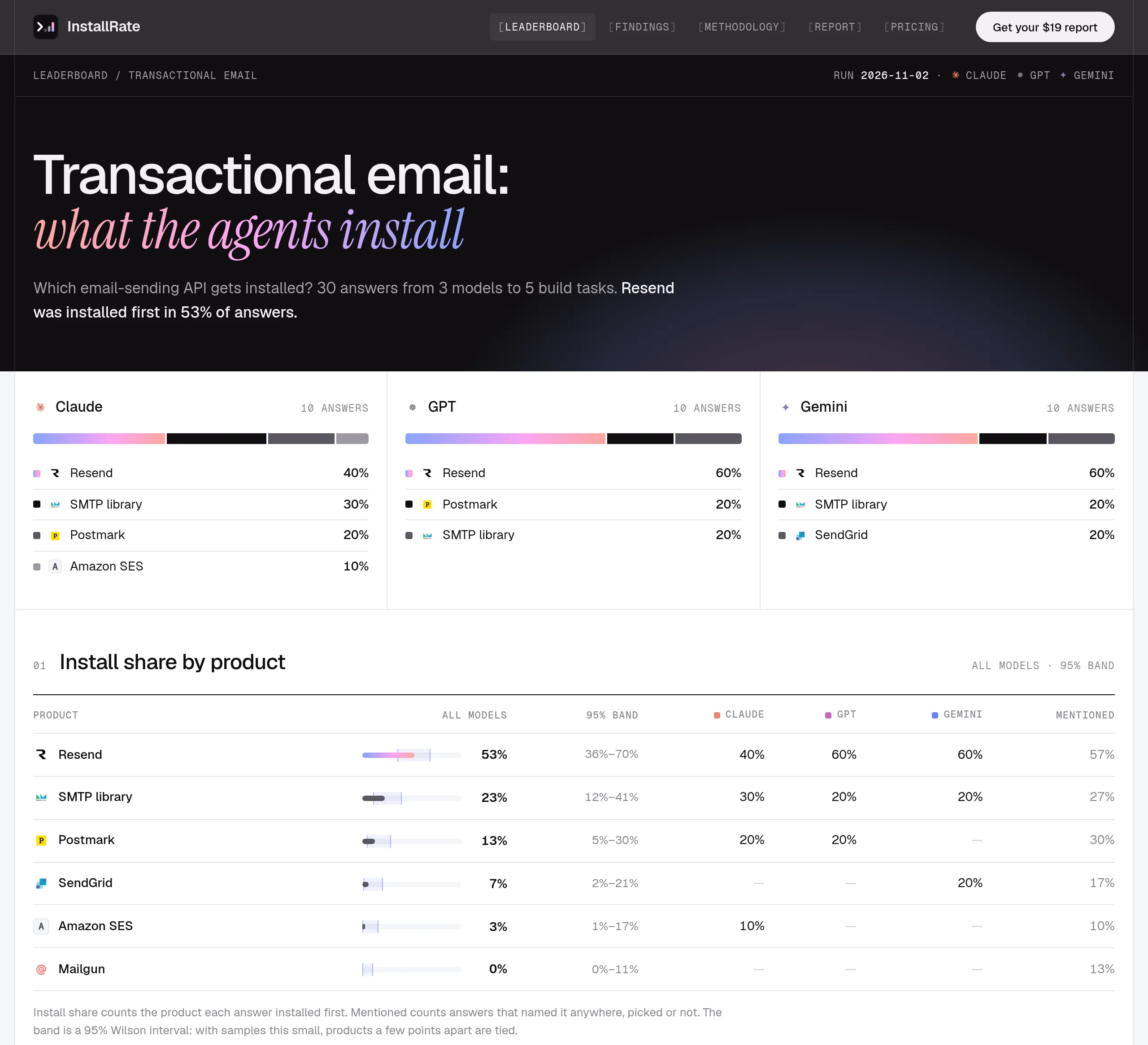
This is the one I didn’t expect. SendGrid has been around since 2009 and is part of Twilio. Resend only started in 2023. In this run, the agents installed Resend in 16 of 30 email answers, and SendGrid in 2.
Resend16Postmark4 SendGrid2Mailgun0
Run of 2 Nov 2026. installrate.com/leaderboard/email
InstallRatemomenelshamy.com
InstallRatemomenelshamy.com
Then I checked whether the market looks the same outside my test. npm’s public download counts for the four email SDKs tell the same story. Resend’s share went from almost nothing in January 2023 to 65% in October 2026. It passed SendGrid in March 2026. In October alone, Resend’s package was downloaded 58.9 million times, and SendGrid’s 21.3 million.
Resend 65%SendGrid 24%Postmark 6%Mailgun 5%2023202420252026npm registry download counts, January 2023 to October 2026, read on 12 Nov 2026. Downloads include CI and bots, so they show direction, not customers or revenue.
 Momen Elshamymomenelshamy.com
I can’t prove the agents caused this. Resend is also simply easy to start with, and it was made with React developers in mind: it won every answer on the two Next.js tasks. But the agents’ default and the download curve point the same way, and the curve got steepest in 2025 and 2026, the same two years coding agents took off. For a company that sells to developers, that’s the new reality.
What I take from it
If you sell to developers, part of your funnel now runs through an agent that types the install command for them. That reader doesn’t see your landing page. It sees your package name, your docs and how short your setup is. Neon’s driver goes in with one line, and the models describe Supabase as a bigger platform. That’s true, and it’s why Supabase ends up as the alternative and not the default.
And as a builder, I’ve stopped taking the default for granted. The model’s first pick is often good. It isn’t always the best tool for my case, so when it matters, I name the tool myself.
The limits
These are answers from the models’ APIs, not agents working inside a real project with its own files and history. 30 answers per category is a small sample, so treat a gap of 2 or 3 as a tie. And models change every few months, so every run carries its date.
Every prompt and every raw answer is public: the leaderboard, the method, the raw data, and one short write-up per finding. If a number here looks wrong to you, you can check it there.
Momen Elshamy. Say hello, or follow me on LinkedIn.